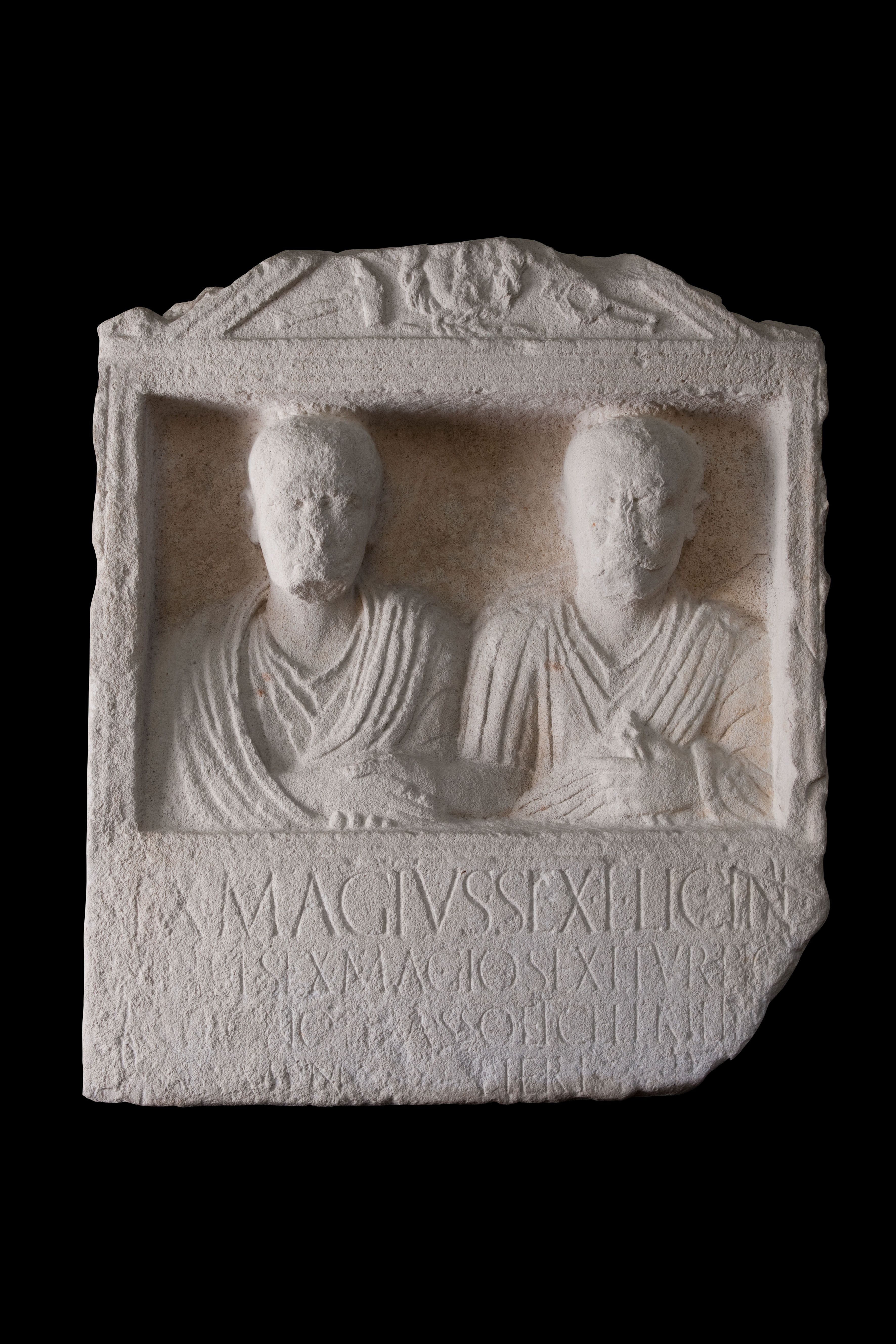
Funerary Stele of the Blacksmiths
Civico Museo Archeologico di Milano
Late 1st century A.D.
Istrian stone
Alongside more complex architectural structures, the most widespread and adopted funerary monuments by the middle classes in the 1st and 2nd centuries A.D. are altars and steles in stone decorated with portraits of the deceased and inscriptions where key identifying data were inscribed in a few lines carved in stone. The epigraphs and accompanying images are therefore important testimonies of the community of Mediolanum in the Roman age, which we discover to be particularly dedicated to entrepreneurial and commercial activities. This is the case of the selected specimen offered by the freedman Sesto Maggio Licinio to himself and his patron Sesto Magio Turpio, with whom he was bonded by affection and profession: they were indeed partners in a blacksmith enterprise, as clearly indicated by the tools, hammer and tongs, held in the hand of the character on the right, likely the patron with a signet ring on his finger. The professional collaboration is represented by the gesture of dextrarum iunctio, or the handshake that had legal value in Rome. Both are dressed in togas, the attire of a Roman citizen, but have different traits and hairstyles to distinguish the two men in a sort of portrait. The tympanum, on which traces of dolphins can be read, companions in the afterlife journey, has at its center a head of Medusa, a monstrous being capable of petrifying with a glance, whose image in art guaranteed protection, alongside which the symbols of the blacksmith enterprise are reiterated: hammer and tongs.
Present in
Civico Museo Archeologico - Monastero maggiore di San Maurizio
Corso Magenta 1520123 Milano