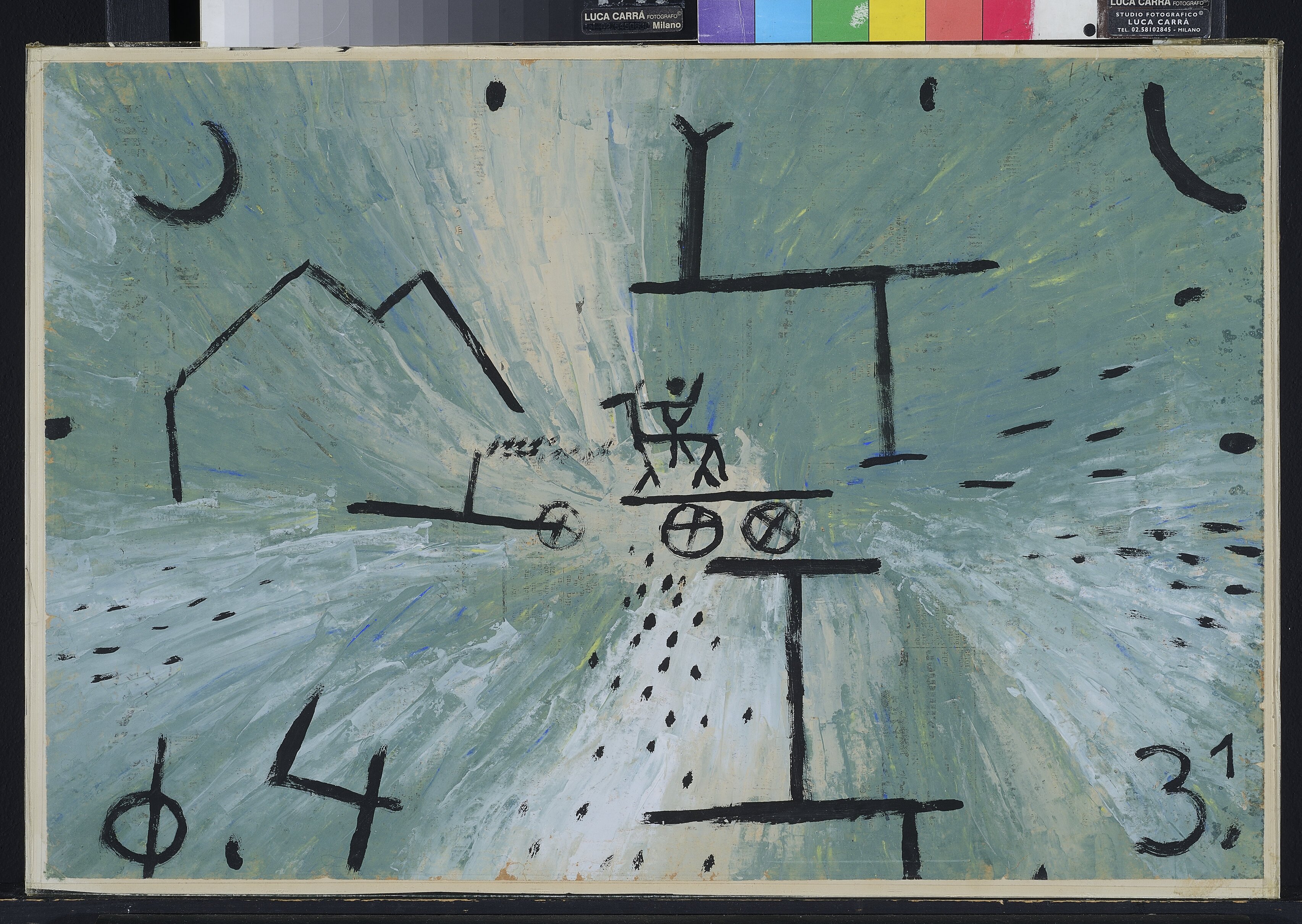
Regina nella tempesta
Fondazione Pasquinelli
1938
tempera on newspaper
This painting dates back to the last difficult period of Klee's life, which began with his forced return to Switzerland following the Nazi takeover in 1933, followed by the onset of a severe illness in 1935, and then the confiscation of his works from German museums—culminating in their public denouncement at the infamous Munich exhibition of "degenerate art" in 1937, alongside the works of many other protagonists of modern art renewal, concluding with the war and his death in 1940.
It is a tempera executed on makeshift support, newspaper, which can be glimpsed beneath the color. The predominance of thick black figures and signs compared to the lighter graphic systems developed in previous years is a stylistic choice typical of those years, sometimes linked to a psychological and physical condition put to the test by circumstances.
It is a time when graphics regains new centrality over painting: a sort of return to origins, to the first decade of the century, when—though in a decidedly different manner derived from secessionist and symbolist influences—graphics was indeed Klee's favored expressive medium, before the "discovery" of color and painting during his trip to Tunisia in 1912.
According to the list of exhibitions in the catalog of the 1966 exhibition at the Galatea Gallery in Turin, the work was exhibited—not only in Amsterdam in 1963, as indicated by a label on the back reading "kunstengar (artist) and the title Direction in a Storm"—but also at the Tate Gallery in London in 1966.
Present in
Fondazione Pasquinelli
Corso Magenta 4220123 Milano