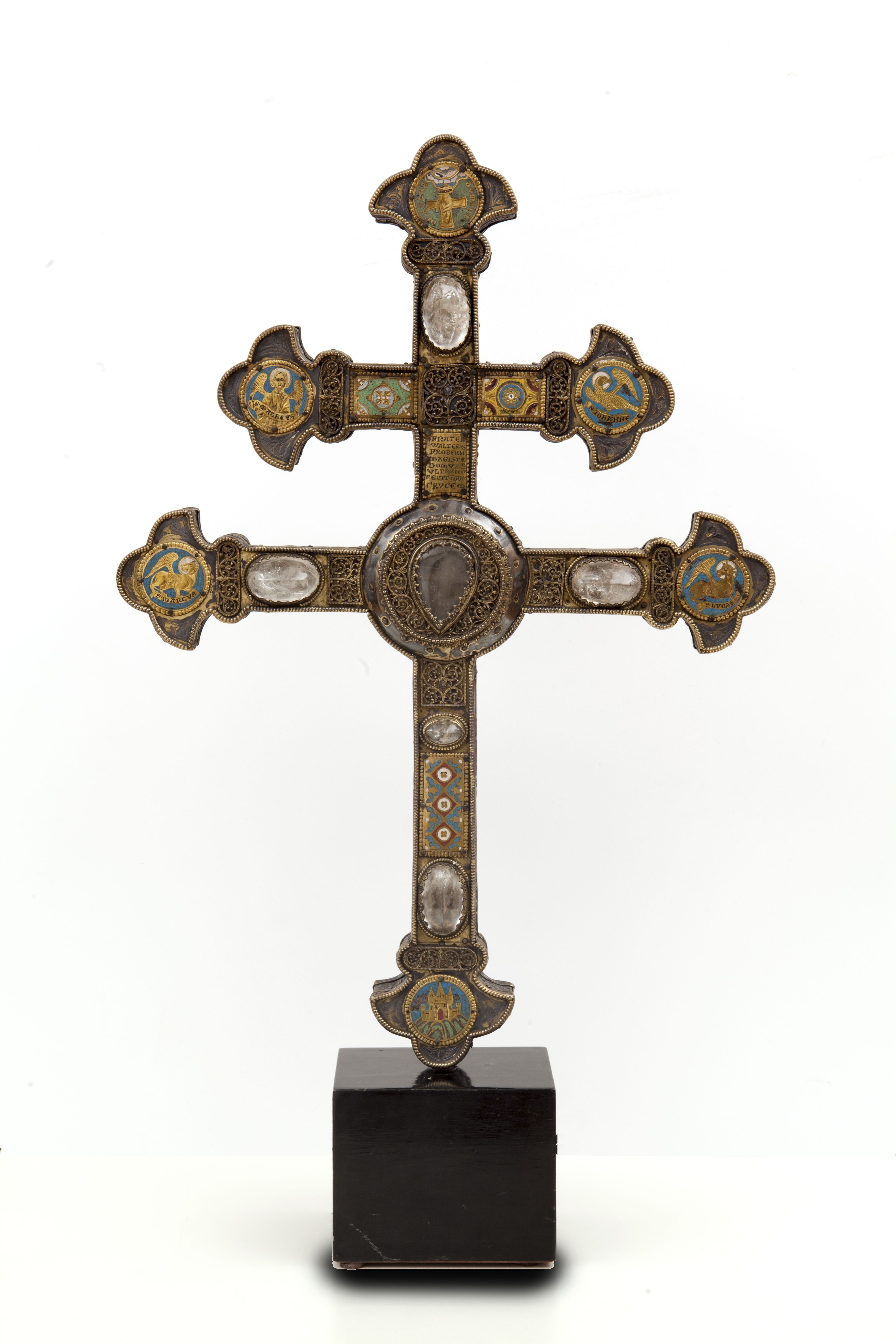
Reliquary Cross
Museo Diocesano Carlo Maria Martini
prima metà del XIII secolo
Silvered copper, filigree, champlevé enamel, cloisonné enamel, niello (?), rock crystals
Dating to the first half of the 13th century, the cross originates from an area between the ancient Low Countries and northern France, and was intended to hold relics of the True Cross. An inscription links it to the city of Utrecht, suggesting interesting hypotheses about its commission: a plaque on the front bears an inscription referring to a ‘frater magister’ of a ‘domus’ in Utrecht, indicating a commission related to a chivalric order, and likely the mysterious building depicted on the medallion is to be read in relation to the inscription. The type is that of a crux gemina, a cross with a double beam, a form of Byzantine origin commonly used to contain relics of the True Cross; the lily-shaped terminations were particularly widespread in northern and France central and in the area between the Meuse and the Sambre. The presence of the spike indicates that originally the cross could be inserted onto a staff or base: the work likely had a triple function: reliquary of the True Cross, processional cross, and non-stationary altar cross. On the terminations of the arms and the upright are medallions with the symbols of the Evangelists and the hand of God. The remaining parts of the cross contain decorative enamels, filigree elements, and rock crystals; the rest features an aniconic decoration with elements of blue-turquoise cloisonné enamel.
Present in
Museo Diocesano Carlo Maria Martini
Piazza Sant'eustorgio 320122 Milano